

Telehandler vs Forklift: Which One Does Your Site Need?
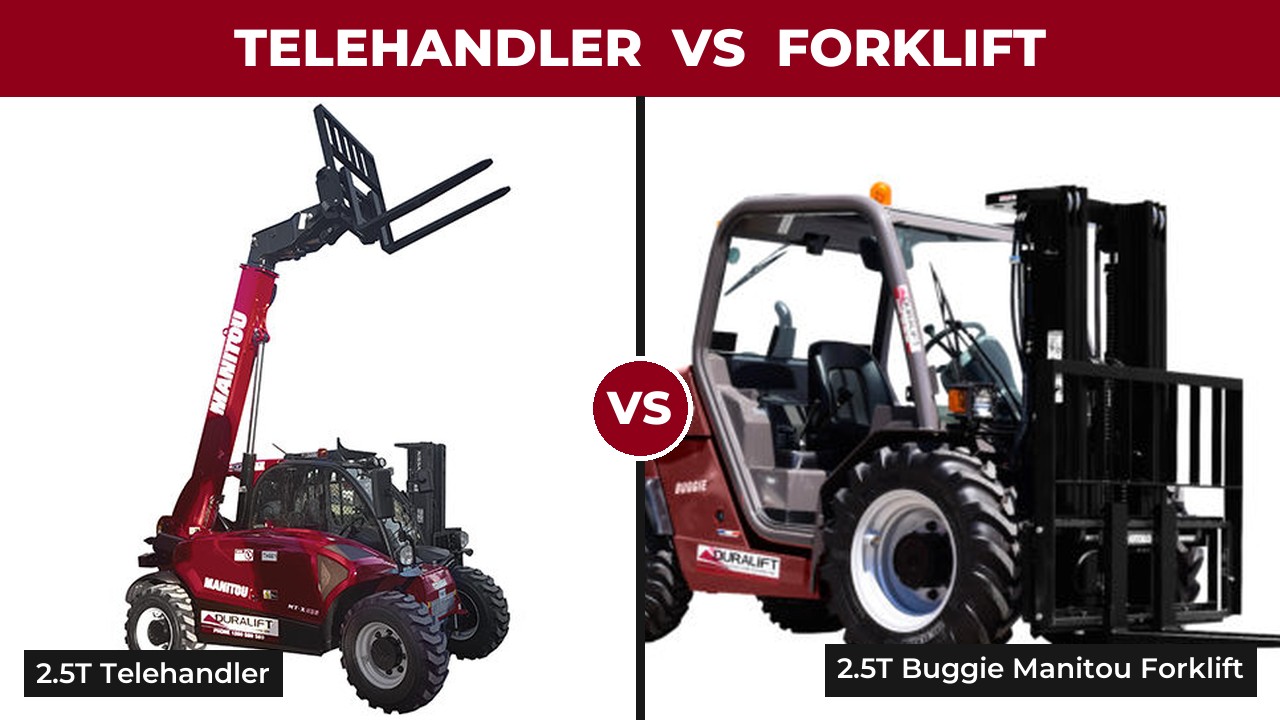
A telehandler and a forklift both lift loads with forks, but they do very different jobs. A standard forklift lifts loads vertically over a relatively short distance, which makes it the right call for warehouse, dock, and container work on flat ground. A telehandler (short for telescopic handler) uses an extending boom to lift loads up, out, and over obstacles, with rough-terrain capability built in.
The forklift vs telehandler decision usually comes down to where you’re working. On a flat slab with stacked pallets, a forklift is faster and more efficient. On a building site or civil works where materials need to go onto a scaffold, into a truck, or over a fence, a telehandler is the right tool.
Comparing capability: reach, terrain, and load handling
Forward reach is the difference that matters most. A standard forklift lifts straight up. A telehandler’s telescopic boom extends forward and up, letting you place loads exactly where they need to go without repositioning the machine. A 2.5 tonne telehandler typically reaches around 6m vertically and 3-4m horizontally, enough to feed materials onto a first-floor scaffold from ground level.
Ground conditions matter too. A rough terrain forklift (also called an all terrain forklift or off road forklift) has larger pneumatic tyres and higher ground clearance for unsealed sites. A 4WD forklift handles ground that would stop a standard model dead. Duralift’s 2.5T Buggie Manitou is a good example. Telehandlers are rough-terrain by default, with most running 4WD chassis, locking diffs, and serious tyre treads.
A slewing telehandler adds another dimension. The upper structure rotates 360 degrees, so the operator can pick up a load and place it behind or beside the machine without driving anywhere. You’ll see slewing telehandlers on tight civil sites and infrastructure projects where space is at a premium.
Attachments expand both machines. Forklifts run tyne extensions, jibs, rotators, and safety cages. Telehandlers run all of those plus buckets, grabs, and lifting hooks, which is part of why the telehandler forklift hybrid has become the do-it-all machine on modern construction sites.
Choosing the right machine for your site
A standard forklift suits warehouses, distribution centres, retail backrooms, and any flat-ground material handling. Rough terrain forklifts suit outdoor yards, landscaping, and unsealed access. Telehandlers earn their keep on construction, civil works, scaffold loading, and roof material placement where reach and terrain capability both matter.
Tell the Duralift team the load weight and the site conditions, and we’ll pick between a compact gas forklift, a 4WD forklift, or a 3-tonne telehandler for you. Two-hour delivery is standard across Melbourne.
Browse our telehandler hire range or call 1300 580 580 for a quick quote.
