

Platform Material Lifter vs Duct Lift: What’s the Difference?
03 November 2026 0 Comments
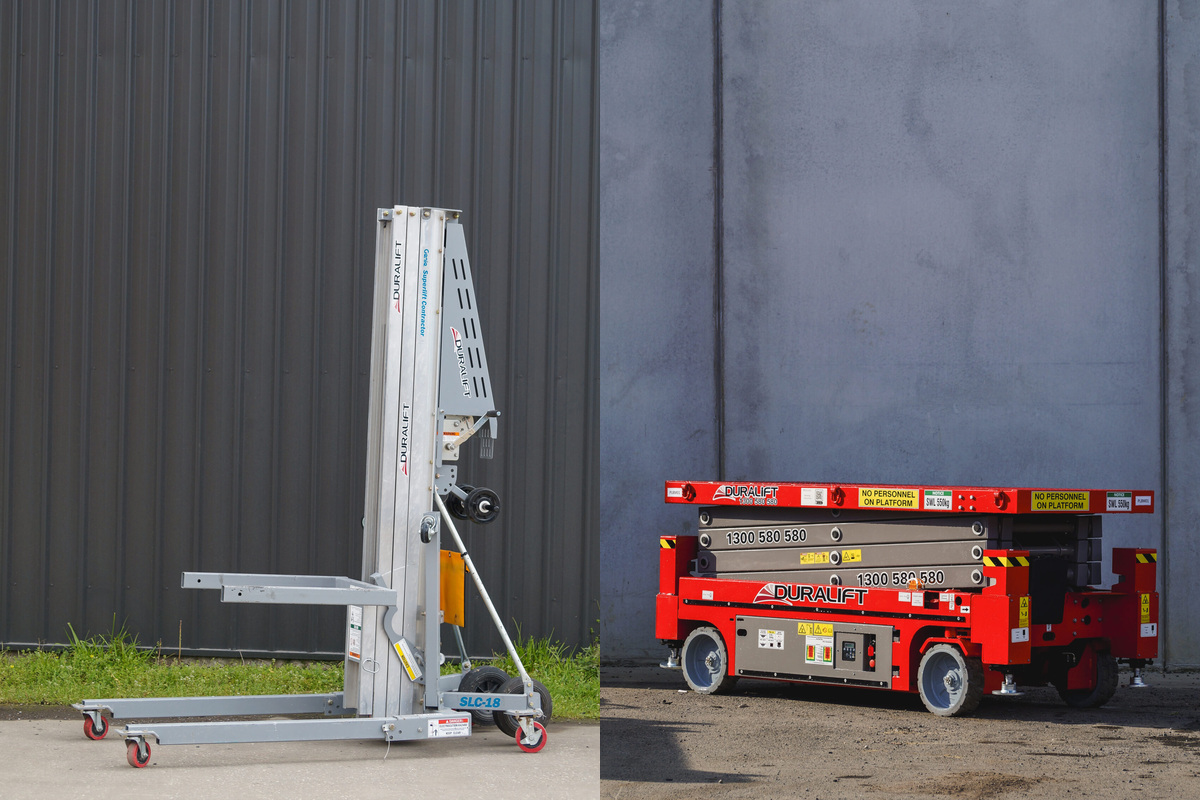
A duct lift and a platform material lifter both raise materials, not people, but that’s where the overlap ends. A duct lift, also sold as a duct lifter or winch lifter, is a slim, portable lifter with forks that one person wheels into place and winds up by hand. A platform material lifter is a battery-powered machine with a flat deck that carries heavier, longer loads and can drive while raised.
Plenty of tradies call both a material hoist, which is why the two get mixed up when booking material lifting equipment.
How a Duct Lifter and a Platform Material Lifter Work
Our duct lifters are Genie units in 18ft and 24ft sizes, reaching working heights of 5.64m and 7.32m. Both carry up to 295kg with the load close to the mast, dropping to 193kg once the load centre moves out to 0.61m. At 0.8m wide and 2.18m tall when stowed, the 18ft model weighs just 139kg, so it rolls through most doorways and travels in a van or on a ute tray. Swap the forks for a pipe cradle, boom or load platform. We also make our own duct lift plate attachment, which sits over the forks so narrow, heavy items like aircon units and batteries sit flat instead of balancing on the prongs. That’s why HVAC crews often call it an aircon lifter. The platform material lifter is a different beast. Our new 8m PML08 is an electric material lift with a 2.71m-long deck, six tie-down points and a 550kg capacity. It takes loads up to 5m long, auto-levels on slopes up to 10° front to back and 15° side to side, and drives at full height. For indoor work with less floor space, the 6m platform material lift raises 270kg to 5.8m on a 0.8m x 1.68m deck.Choosing the Right Material Lifting Equipment for Your Site
A duct lift suits ceiling-level installs where the load is compact and space is tight. Ductwork, split-system heads, pipe runs and cable trays in an office fitout or shopping centre are its bread and butter. One installer can wind the load up, hold it steady and fix it off without a second person propping it. The platform material lifter earns its keep on bigger jobs. Bundles of steel, plasterboard sheets, conduit lengths or plant heading up to a mezzanine all fit its deck. Because it drives with the load raised, you can lift once and travel along a wall rather than lowering and repositioning between every drop. Both sit within our wider material handling equipment range alongside forklifts, telehandlers and pallet jacks. Not sure which way to go? Tell us the load weight, install height and site access, and we’ll match the machine to the job. Delivery runs in two-hour windows across Melbourne, so call 1300 580 580 or request a quick quote online.Frequently Asked Questions
Is a duct lift the same as a material hoist?
Mostly, yes. Material hoist is a broad trade term that covers duct lifts and similar mast-style lifters, so a duct lift, material hoist lift or material lifter can all mean the same thing on a quote request. A platform material lifter falls under that umbrella too, but it's a much bigger machine. Neither should be confused with the fixed material hoists bolted to a building or scaffold on high-rise jobs, which are a separate class of equipment.
What's an aircon lifter?
It's another name for a duct lift used to raise air conditioning units into ceilings or onto brackets. Pair it with our plate attachment for small, heavy units that won't sit securely on the forks.
How much can each machine lift?
At maximum capacity, the three compare like this:
Duct lift (18ft or 24ft): 295kg, to 5.64m or 7.32m working height
6m platform material lift: 270kg, to 5.8m
8m platform material lift: 550kg, to 8m
Which material handling equipment works on uneven ground?
The 8m platform material lift. Its auto-levelling copes with slopes up to 10° front to back and 15° side to side, and integrated outriggers keep it stable once set. Duct lifts and the 6m model are best kept to firm, level floors. Our guide to access equipment for uneven ground covers sloped sites in more detail.
Should I hire a manual or electric model?
For loads under 295kg going into a ceiling, a manual material lift does the job. Our manual duct lifter needs no charging or power supply, and the winch gives fine control when you're lining up a fixing. Once loads get heavier or longer, or you're making dozens of lifts a day, an electric material lift takes the winding out of it and covers more ground. If you've been searching for an electric duct lifter, the 6m platform model is usually the better fit, since it powers both the lift and the drive.
Can I transport these lifts myself?
The duct lift, yes. It's a portable material hoist that stows at 2.18m tall and weighs 139kg to 170kg depending on size, so it fits in a van or ute. If you need a portable duct lifter for jobs across town, this is the one. The platform material lifters weigh 1,250kg (6m) and 2,550kg (8m), so leave the delivery to us.
Do I need a licence to operate a duct lift or platform material lifter?
No Yellow Card or WP licence is needed, since nobody rides either machine. WorkSafe Victoria's HM licence class applies to cantilever platform materials hoists fixed to a structure, not portable lifters like these. Site rules still apply, so check your principal contractor's induction requirements and ask our team to run you through the controls when you book.
