

Best Access Equipment for Uneven Ground: Scissor Lifts, Tracked Booms and Telehandlers Compared
When the ground isn’t flat, the wrong access equipment will sink, tip, or simply refuse to climb the slope, which is why the right machine, whether an all terrain scissor lift, a tracked lift, or a rough terrain telehandler, beats a standard unit every time. Picking the right machine starts with understanding what the ground actually is (soft, sloped, rough, or all three) and matching it to the right combination of drive system, tyres, and stability.
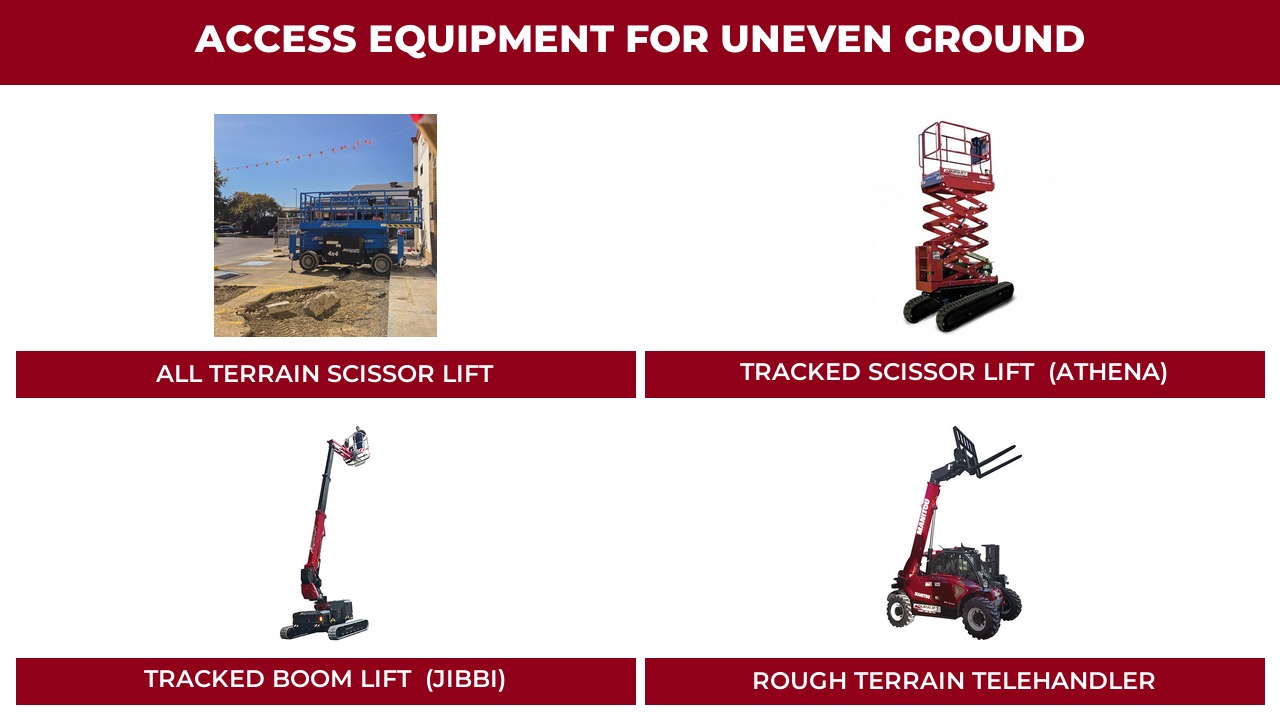
Four families of access equipment are built for difficult ground: all terrain scissor lifts, tracked scissor lifts, tracked or spider boom lifts, and rough terrain telehandlers. Each is built for a specific kind of ground rather than being a general-purpose machine.
Matching the machine to the ground
An all terrain scissor lift, sometimes called a rough terrain scissor lift, is a 4WD diesel unit with large pneumatic tyres and outriggers. It’s the standard pick for compacted gravel, uneven sealed surfaces, and outdoor construction sites where the ground is firm but not flat. Gradeability is typically 35-40%, with platform heights including 26ft, 32ft, 40ft, 43ft, and 53ft. Stable, fast, and capable of carrying multiple workers plus materials.
Tracked scissor lifts swap wheels for rubber tracks, dramatically reducing ground pressure. The Athena bi-levelling tracked scissor lift in Duralift’s fleet, for example, self-levels on slopes up to 20 degrees and spreads its weight over a larger footprint. It’s the right call for landscaped areas, soft turf, or muddy ground where wheeled units would sink or scar surfaces. Light enough to tow on a trailer and narrow enough to fit through a double door.
Tracked boom lifts, like the Jibbi Knuckle Boom, combine reach with ultra-low ground pressure. You’ll see them on church restorations, civic buildings, and high-end residential work where ground protection matters as much as access. A rough terrain boom lift or all terrain boom lift handles difficult ground on a wheeled chassis, which suits sites where reach and speed matter more than surface protection, whereas a spider boom lift deploys stabilising legs that spread its weight across four points (note: we don’t sell these).
Rough terrain telehandlers or forklifts aren’t access equipment in the EWP sense, but they belong in this comparison because they’re often the right answer for material handling on the same difficult sites. The 4WD chassis, locking diffs, and serious tyre treads handle slopes and unsealed surfaces where standard forklifts can’t operate.
Choosing for your site
The match usually comes down to surface sensitivity. Firm but uneven ground (construction sites, gravel yards) suits an all terrain scissor lift or an all terrain boom lift. Soft, sloped, or sensitive surfaces (landscaped areas, turf, heritage paving) call for a tracked scissor lift or a tracked boom lift. Narrow access onto difficult ground favours the tracked scissor lift. For material handling on the same sites, a rough terrain telehandler does the lifting.
The wrong call wastes a day and a delivery fee. Send the Duralift team a couple of site photos and the load you need to lift, and we’ll tell you what fits before the truck leaves the yard.
Browse Duralift’s access equipment range or call 1300 580 580 to talk through your site.
